
Blog


The Carbon Footprint of an Event and What You Can Do About It as an Organizer

We’re seeing more and more how sustainable event planning is becoming a powerful marketing draw. But where do the words end and real impact begin? Is it more important to offer a meat-free menu, or to ensure easy access by public transport? And how big a role can effective communication actually play?

Sustainable event planning is becoming an increasingly prominent topic—not just as a marketing argument. The way you design and deliver an event directly shapes how people perceive it, how much it costs, and what remains after it’s over. Most of us already understand that environmentally responsible solutions are not “just” a gesture toward nature and a sustainable future, but also bring immediate benefits. A well-designed sustainability strategy can reduce environmental impact while saving money at the same time.

The carbon footprint of events is an important issue for both partners and attendees. Thoughtful spatial design or, for example, creative additions to catering—like innovative vegan cuisine—can become the elements people keep talking about long after the event ends.

At the same time, the carbon footprint is one of the key tools for translating an event’s environmental impact into concrete numbers and making it easier to understand. It includes emissions related to the venue, transportation of attendees and organizers, accommodation, catering, production, temporary structures, technical equipment, and communication.

Where organizers most often go wrong

One of the most common mistakes is leaving sustainability considerations until the very end—or even addressing them only retrospectively. If sustainability isn’t set as a priority from the outset in the internal brief, there is usually little room left for meaningful changes, and the result tends to be a set of minor measures with limited impact.

Another common issue is staying at the level of a vague intention: “we want to be sustainable.” Without clear, concrete goals, it becomes difficult to decide what to prioritize. It helps to define in advance where your actions will have the greatest impact, what matters most to you, and—crucially—what is realistically achievable.

If you’re new to organizing events, there’s no need to set unrealistically high expectations. What matters is understanding your own capacity and choosing steps that won’t become a major obstacle to delivering the event. At the same time, it’s important to recognize that sustainable practices don’t happen on their own—some additional effort will always be required.

If you organize similar events repeatedly, you shouldn’t lower your sustainability ambitions. Each new edition is an opportunity to take at least one step further.

Where to start: transport and venue

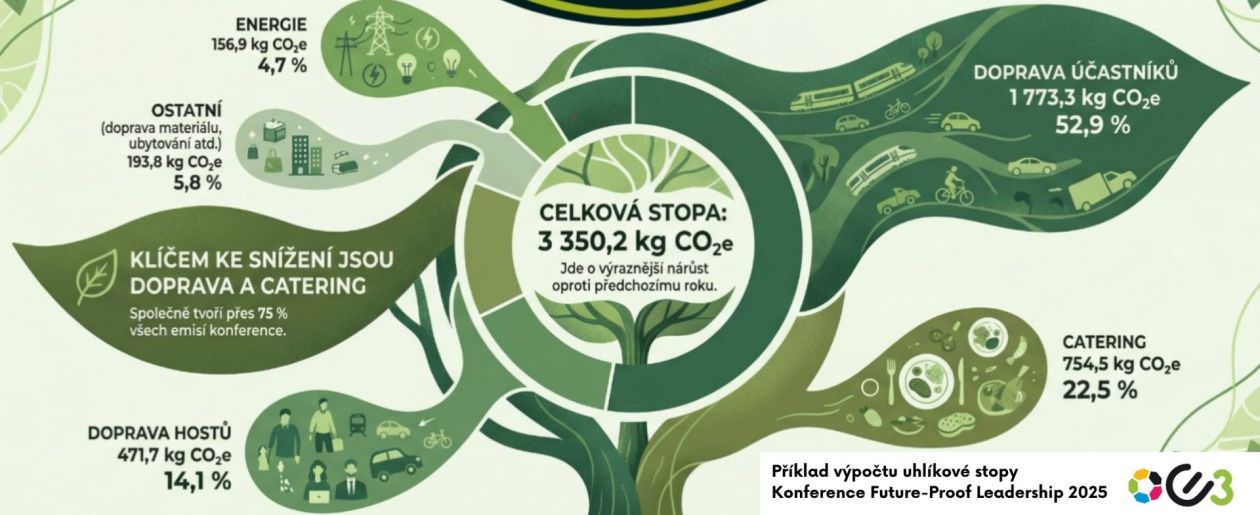
When looking at carbon footprint assessments for most events, one conclusion appears consistently: the largest share of emissions comes from attendee transport. Scope 3 emissions—those outside the organizer’s direct control—typically account for 70 to 90 percent of an event’s total carbon footprint, with attendee transport usually being the single largest contributor. Even so, there are ways to influence it to some extent.

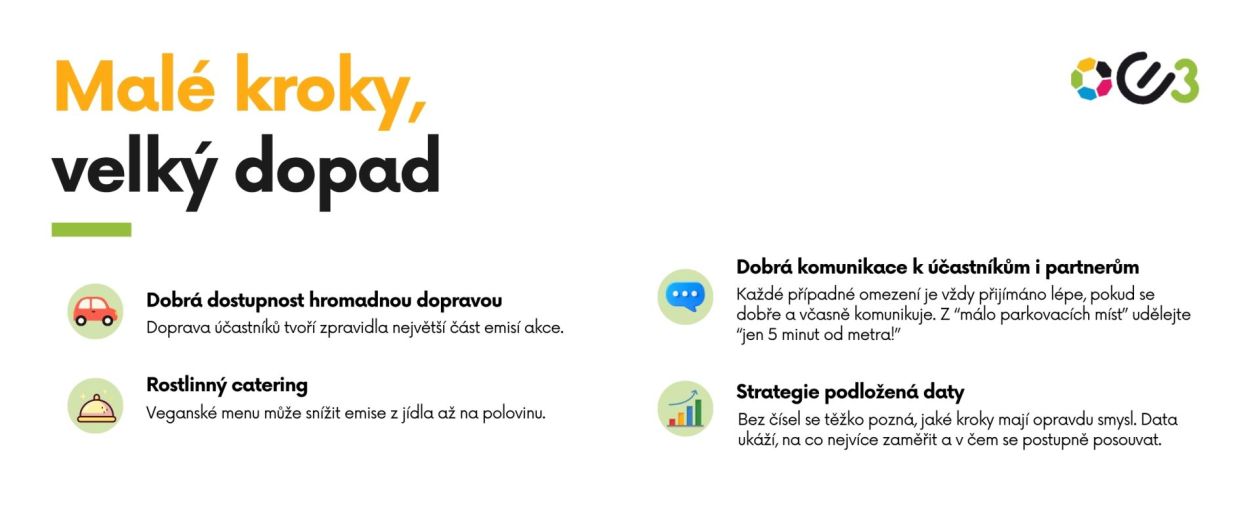
The first factor is accessibility. If an event is easy to reach by public transport, the likelihood that people will actually use it increases significantly—unlike when an event is held in a venue in the middle of nowhere. To avoid frustration over limited parking, it’s a good idea to clearly communicate conditions in advance and ideally provide specific transport connections. For larger events, encouraging carpooling or arranging shared transport can also make sense.

The choice of venue has a greater impact than it might seem. Selecting the right capacity helps reduce unnecessary energy use. Natural daylight lowers the need for artificial lighting, and good insulation reduces heating or cooling demand. These seemingly small details add up and can have a significant overall effect.


Catering, waste, and goodie bags

No matter how strong your program or how impressive your speakers are, catering will always be a topic of conversation among attendees. Plant-based food is no longer just an option for a small niche—it can be fully-fledged, creative, and often surprises even those who wouldn’t normally choose it.

A vegan menu at an event can reduce food-related emissions by up to half compared to an average diet. A major added benefit is sourcing ingredients locally.

Managing quantities is just as important. Oversized portions or poor demand estimates lead to food waste, increasing both costs and environmental impact. This is also an important economic factor—you don’t end up spending more on catering than necessary.

Waste is generated not only by food itself, but also by how it’s served. Switching to reusable tableware can significantly reduce waste while also creating a more natural and higher-quality impression for attendees. However, it does come with logistical requirements: you need storage space and someone to handle cleaning after the event.

A simple yet impactful step toward waste reduction is avoiding bottled water. Fortunately, we live in a country with very high-quality tap water—so it makes sense to take advantage of it.

It’s also worth rethinking event giveaways. Here, quality should take precedence over quantity. Most of us have attended events where we left with a bag full of items we never used. Instead, consider promotional items that attendees will genuinely find useful.

Communication as the key to success

Sustainability doesn’t have to mean inconvenience. But if attendees do need to make a compromise—such as fewer parking spaces or a plant-based menu—the way you communicate it makes all the difference. Done right, communication can turn a potential limitation into a positive part of the experience.

The key is timing and clarity. Frame messages positively: instead of saying “parking is limited,” try “the venue is easily accessible by metro, with the nearest station just a five-minute walk away.” Transparency also plays an important role. Sharing concrete numbers or goals—for example, aiming to reduce waste by a third compared to last year—helps attendees feel part of something meaningful, while also setting a benchmark for future improvements.

Inspiration from abroad: what works in practice

The best proof that sustainable events are not a utopia lies in real-world examples that have been running successfully for years and receiving recognition for their efforts. We Love Green is a Paris-based festival held in Bois de Vincennes, now considered one of the most sustainable cultural events in Europe. Since 2023, it has served exclusively vegetarian food—this shift alone reduced the festival’s food-related carbon footprint sevenfold.

All meals are subject to strict auditing (seasonality, locality, organic farming), 95% of beverages come from France, and 80% are sourced within a 200 km radius. Transport accounts for more than half of the festival’s total footprint, so organizers actively promote public transport and offer free shuttle buses. The festival was among the first to receive ISO 20121 certification and has been awarded the “Outstanding” rating by A Greener Future.

The same recognition has been awarded to Norway’s Øyafestivalen, often described as the most sustainable music festival in the world. Held in central Oslo, the vast majority of attendees arrive on foot, by bike, or via public transport. More than 95% of the food served is organic, the festival uses the local renewable-powered electricity grid instead of diesel generators, and its recycling rate exceeds 75%. It has also introduced carbon labels on food to help guests make informed choices.

Both events are certified by A Greener Future, an internationally recognized authority in sustainable festivals and events. The organization evaluates events across eleven categories—from transport and food to energy, waste, equality, and local community impact—and awards certifications at levels such as Commended, Highly Commended, and Outstanding.

That said, when organizing your own event, you don’t need to match these examples to call your efforts sustainable. Continuously gathering inspiration and implementing what works elsewhere is already a strong step in the right direction.

Measuring the carbon footprint of an event

An event’s carbon footprint is not an abstract concept—it’s the result of working with concrete data. Basic data collection includes the approximate number of attendees, event duration, information about how participants and speakers travel (even rough estimates), the amount of catering ordered, and the volume of leftover waste.

After the event, it’s valuable to document “lessons learned.” What had the biggest impact? What worked smoothly? What proved unnecessarily complicated? And what will you do differently next time? Over time, this process becomes a natural part of event planning.


CI3 and CarbonFix: expertise you can rely on

Calculating carbon footprints is nothing new for us at CI3. We are the longest-established organization in carbon footprint assessment in the Czech Republic. We’ve completed hundreds of calculations across companies, institutions, and events, and we know exactly where the biggest opportunities for improvement lie within the numbers.

For event organizers, we’re ready to calculate the carbon footprint of your event from start to finish—whether it’s a corporate conference, a festival, or a community gathering. To support this, we’ve developed our online tool CarbonFix, including its new version specifically focused on event carbon footprints: CarbonFix Event. It is verified according to ISO 14064-3 and built on the internationally recognized GHG Protocol. The results are clearly structured into eight thematic areas, allowing you to immediately see where emissions are generated and where it makes the most sense to start reducing them.

A sustainable event is not about perfection, but about direction and continuous improvement. The carbon footprint is a key tool that helps organizers make informed decisions and identify where to begin. Each event can then become a step more sustainable than the last.


Sources:

  1. Carbonmark – Understanding the Carbon Footprint of the Events Industry (2026): https://www.carbonmark.com/post/understanding-the-carbon-footprint-of-the-events-industry

  2. Frontiers in Nutrition – Vegan diet can halve your carbon footprint (2025): https://www.frontiersin.org/news/2025/11/11/frontiers-nutrition-plant-based-diets-reduction-carbon-emissions-land-use

  3. We Love Green – Green page (welovegreen.fr): https://www.welovegreen.fr/green/?lang=en

  4. ISO 20121:2024 – Event sustainability management systems: https://www.iso.org/standard/86389.html

  5. A Greener Future – World's Greenest Events & Festivals 2024: https://www.eventindustrynews.com/news/a-greener-future-reveals-the-worlds-greenest-events-festivals

  6. The Cooldown – What is Øya Festival? Inside the 'world's greenest music festival': https://www.thecooldown.com/green-business/oya-festival-oyafestivalen-sustainable-norway-music/

  7. CarbonFix – CI3 s.r.o.: https://www.carbonfix.cz/

Back

Interested in CI3 Services?

Fill out and submit your contact details, and we will get back to you within 1 business day:


CI3, s.r.o.Headquarters:Jeronýmova 337/6, 252 19 Rudná
Office:Oldřichova 517/33, 128 00 Prague 2

Company ID:11667770
VAT Number:CZ11667770, VAT payer C 352575, registered at the Prague City Court

E-mail:info@ci3.co.cz
Phone:+420 736 162 066
Data Box ID:ecr8i7j

LinkedIn:cz.linkedin.com/company/ci3-s-r-o

This website uses cookies

We use cookies on this website to ensure proper functionality, optimization, for range analysis and statistics. The data collected is anonymous and is shared with our partners who take care of the operation and functioning of the website. Without your consent, we can only store cookies that are necessary for the operation of this website. For all other cookies we need your consent, which you can give or withdraw at any time in the cookie settings. Translated with DeepL.com (free version)

Essential cookies are those without which the site cannot function properly. We can't do without cookies to save your login.

Preference cookies allow us to remember your settings, such as filtering and sorting or language.

Statistical cookies help us to understand how you use our site. We use a third party service that is committed to collecting data anonymously - but requires cookies to function properly.

EssentialSettingsAgree with all