
How Transport Contributes to a Company’s Carbon Footprint: Practical Tips for Reducing Transport Emissions
From small cafés to nationwide retail chains, transport-related emissions affect virtually every business, whether they come from importing or exporting goods or from employees commuting to work. At the same time, transport is an area where emissions can often be significantly reduced through efficient logistics.
Emissions cannot be eliminated at the snap of a finger simply because a company decides to do so. Transport often connects different parts of the supply chain, which means that any meaningful change needs to be addressed on several levels.
The first step is therefore to understand how transport actually works within the company. How many kilometres do vehicles travel? How fully are they loaded? What types of vehicles does the company use? How much freight is transported, and over what distances? And where is there room for more efficient solutions?
Most transport emissions fall under Scope 1 and Scope 3
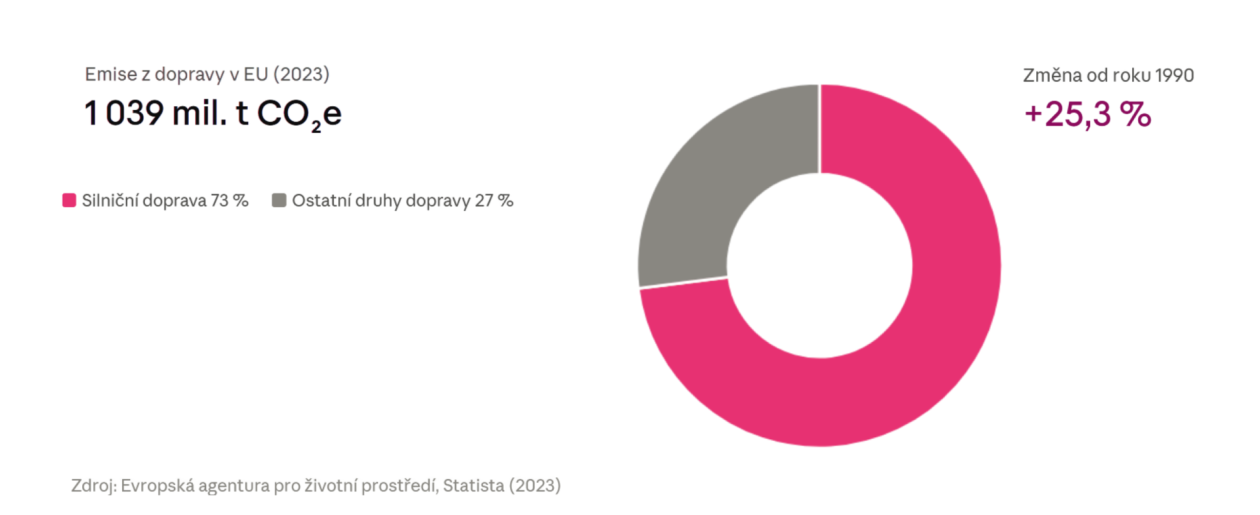
Transport has long been one of the largest sources of greenhouse gas emissions worldwide. It is also the only sector in which the European Union has failed to reduce emissions compared with 1990 levels. Quite the opposite. According to the European Environment Agency, emissions from all transport in the EU increased by 25.3% between 1990 and 2023, reaching 1.039 billion tonnes of CO₂ equivalent in 2023. That represents roughly 31% of all greenhouse gas emissions in the EU.
Road transport accounts for the largest share. In 2023, it was responsible for around 73% of transport emissions in the EU. The Czech Republic has had a strong railway tradition since the Austro-Hungarian era, and according to Eurostat it still ranks among the EU countries with the densest railway networks. Nevertheless, road transport has long dominated domestic freight transport here as well. In recent years, more than 80% of the total weight of goods transported domestically has travelled by road on average. Rail accounts for approximately 17%, while pipeline transport of crude oil comes third at around 2%.
Different forms of transport appear across all three “scopes” when calculating a company’s carbon footprint under the GHG Protocol. If a company owns or directly operates cars, vans or trucks, emissions from fuel combustion fall under Scope 1. If it charges electric vehicles using electricity from the grid, the electricity consumed is included in Scope 2. Transport provided by external carriers, business travel by air, or employee commuting typically falls under Scope 3.
In practice, the vast majority of transport-related emissions fall under Scope 1 and Scope 3. These are also the two areas where companies usually have the greatest opportunity to reduce emissions, either directly through their own vehicle fleet or indirectly through supplier selection and corporate travel policies.
From Small Changes to Bigger Steps
Let’s start with Scope 1. As in other areas, it is always worth first considering what can be done immediately and without major investment. Before a company starts thinking about replacing its entire vehicle fleet with electric vehicles or making another large investment, it makes sense to look at the basics: how efficiently transport is currently being used.
Sometimes the biggest savings can come from surprisingly simple changes. Better route planning can reduce unnecessary mileage. More efficient use of vehicles can help cut the number of journeys. Regular monitoring of fuel consumption can reveal vehicles or types of operation where consumption is unusually high. In freight transport, vehicle utilisation and the choice of a more suitable mode of transport can also play a significant role.
Only then do larger changes come into play, such as the gradual electrification of the vehicle fleet, changes to transport routes, greater use of rail, or a shift towards other less carbon-intensive modes of transport. Among the measures recommended by the GHG Protocol are improving transport efficiency, shortening transport distances, and shifting to less emissions-intensive modes of transport.
For a company to decide which changes genuinely make sense, however, it needs high-quality input data. This is particularly important when it comes to corporate transport. If we do not know how much vehicles are being used or which routes they travel, it is very difficult to identify where the highest emissions are generated and where the greatest potential for savings lies.
This is also why we see significant value in our new partnership with Sherlog, which helps companies manage their vehicle fleets. In addition to features such as an easy-to-use mileage log and reminders for inspections and other vehicle-related obligations, our partnership with Sherlog also enables clients to calculate the carbon footprint of their corporate fleet.
The calculation clearly shows where the highest emissions within the fleet are generated and where there is the greatest potential for reductions. Based on the results, specific measures can then be proposed, ranging from more efficient vehicle use and route optimisation to the gradual renewal of the fleet.

Rail Can Be Part of the Solution Too
But the options for reducing transport emissions do not end there. A company’s own vehicle fleet is only one part of its transport-related carbon footprint. Transport provided by external carriers, business travel, and employee commuting, all of which fall under Scope 3, can also play a significant role.
Freight transport is a typical example. A company does not need to own a single truck to have a substantial carbon footprint associated with transporting its products or materials. If it regularly uses external carriers, it can therefore look not only at the cost and speed of transport, but also at its carbon intensity. Factors such as the type of vehicle used, its average fuel consumption, vehicle utilisation, route length, and mode of transport can all make a significant difference. In some cases, it may therefore make sense to optimise deliveries, consolidate individual shipments, or shift part of the transport from road to rail.
A similar approach can be taken to employee business travel. For shorter journeys, rail or another form of public transport may be a suitable alternative. For longer trips, a videoconference may sometimes replace travel that is not essential. Companies can also introduce business travel policies that take carbon intensity into account alongside cost and travel time when trips are being planned.
A Brief Look at the Legislation
One of the main pieces of European legislation governing sustainability reporting is the Corporate Sustainability Reporting Directive (CSRD). Companies that fall within its scope report in accordance with the European Sustainability Reporting Standards (ESRS).
The CSRD rules have changed several times in recent years. Some companies that were originally expected to begin reporting earlier have been granted a postponement as a result of these changes. For companies in the so-called second wave, this means that, provided they remain within the scope of the requirements after the latest amendments, their first CSRD report will cover the 2027 financial year and be published in 2028.
This year has also brought further changes under the Omnibus I package, which further narrows the scope of mandatory reporting. Under the new rules, the core reporting requirements, including carbon footprint reporting, apply to companies with more than 1,000 employees and either annual net turnover exceeding EUR 50 million or a balance sheet total exceeding EUR 25 million.
However, emissions data remains relevant even for companies outside the scope of the CSRD. They may form part of the value chain of a larger company that needs emissions data for its own Scope 3 reporting. Such data may also be useful when meeting the requirements of business partners, as part of ESG assessments, or simply when looking for cost savings and more efficient operations.
Whether the motivation is legislation, business partner requirements, cost savings, or a company’s own sustainability strategy, the first step remains the same: knowing where you stand.