
Decarbonization as a Strategic Business Advantage
Reducing a company’s carbon footprint doesn’t have to be just an administrative or bureaucratic burden, as many still believe. On the contrary, a well-designed decarbonization strategy can bring numerous significant non-financial as well as economic benefits even to businesses that are not yet subject to legislative requirements.
It’s not only about lowering operating costs through energy efficiency and the transition to cheaper renewable sources, but above all about strengthening competitiveness and sustainability. Large corporations and investors are increasingly demanding sustainability and carbon footprint data from their suppliers and partners, making decarbonization a key criterion for maintaining existing business relationships and securing new contracts. Thus, it is no longer merely an environmental issue, but an effective tool for building more resilient and innovative business operations.
Author: Vladimira Khajlová

Legislative Framework and the Growing Pressure for Transparency
Decarbonization is gradually becoming a key challenge and an inevitable reality for businesses operating in the Czech Republic. Its framework is largely shaped by European Union legislation—particularly the Fit for 55 package and the commitment to achieving climate neutrality by 2050. A crucial tool in this effort is the EU Emissions Trading System (EU ETS), which obliges major polluters—especially in the energy and heavy industry sectors—to purchase emission allowances.
For Czech companies, this means growing pressure and, in many cases, direct obligations, especially in the fields of energy, industry, and transport. Another major piece of legislation is the Corporate Sustainability Reporting Directive (CSRD), which introduces the requirement for regular and transparent non-financial reporting. While it currently applies mainly to large companies, it will gradually extend to small and medium-sized enterprises as well.
However, even smaller suppliers are already facing pressure from their clients to provide their own carbon footprint data, since these are included in the Scope 3 emissions of their customers. The Czech Republic is implementing European targets through its national strategic document, the National Energy and Climate Plan (NECP). This plan, regularly updated and submitted to the European Commission, outlines the decarbonization trajectory of the Czech economy through 2030, with strategic ambitions for 2050. It focuses on reducing greenhouse gas emissions, improving energy efficiency, developing the internal energy market, ensuring energy security, and fostering research, innovation, and competitiveness.
Why Engage in Decarbonization Voluntarily
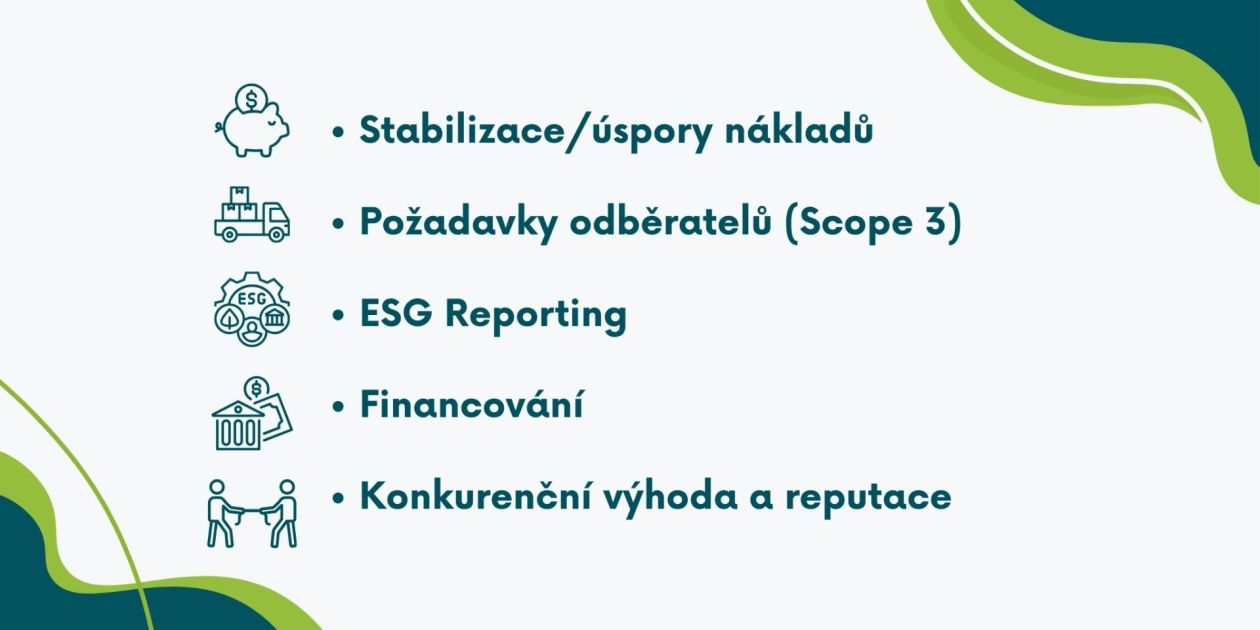
While emission reduction obligations currently apply primarily to large polluters (under EU ETS) and companies subject to mandatory reporting (under CSRD), an increasing number of businesses are choosing to measure and reduce their emissions voluntarily. In the Czech Republic, companies are more frequently motivated by the desire to gain a competitive edge, meet supply chain requirements, and take advantage of available financial instruments.
The main motivation is often the long-term stabilization of costs. Investments in energy efficiency and renewable sources help reduce dependence on volatile energy prices while cutting operational expenses. Another key driver is the growing pressure within supply chains—large corporations now require carbon footprint data from their suppliers, which are included in their own Scope 3 calculations. This pressure is gradually spreading across the entire supply chain, as companies seeking to maintain stable business relationships must be able to provide data and demonstrate emission reductions.
Voluntary decarbonization is also increasingly linked to access to finance. Even though mandatory requirements currently apply to only some businesses, banks, investors, and insurers already consider ESG criteria when granting loans or insurance. Companies with a clear decarbonization strategy therefore have better access to favorable financing options, such as green loans and sustainable investments.
Lastly, decarbonization represents a significant competitive advantage and a source of reputational value. Companies that offer low-carbon products and conduct their business in line with sustainability goals are perceived as innovative and responsible. This strengthens trust among customers and partners, while also making these businesses more attractive workplaces for new employees and talent.
Step One: Calculating the Carbon Footprint
The foundation for creating a decarbonization strategy and defining goals, specific steps, and measures lies in understanding one’s own carbon footprint. The initial calculation serves as a baseline year, against which future targets are set and progress is measured over time. The results also make it possible to divide emissions into categories (Scope 1, 2, and 3) and identify the areas with the greatest reduction potential.
Without knowing its carbon footprint, a company cannot effectively manage or reduce emissions. The calculation provides a realistic picture of where and why emissions occur and enables data-driven decision-making instead of relying on assumptions. Only then can a company set achievable, measurable goals aligned with its operational reality.
From Measurement to Action
Once a company knows its baseline carbon footprint, it can move on to developing a decarbonization strategy. In practice, it’s not difficult to compile an overview of ideal decarbonization measures for each Scope (1, 2, and 3). However, the strategy should always be based on the real possibilities and specific context of the company. From the very beginning, it is crucial to understand the company’s internal processes and established practices — which requires close cooperation between the company’s representatives and the strategy developer.
Ideally, the company starts with itself, setting goals and actions within direct emissions (Scope 1 — e.g., switching to low-emission fuels or using electric vehicles) and indirect emissions (Scope 2 — e.g., purchasing renewable electricity or installing solar panels).
Although Scopes 1 and 2 are the areas a company can most directly influence, growing attention is now being paid to Scope 3 emissions — those generated throughout the supply chain. This is often where the largest share of emissions lies, even though companies cannot directly control them. These may include emissions from purchased materials, products, and services (Scope 3.1), emissions from transportation of these materials to the company (Scope 3.4), or even from product delivery to customers (Scope 3.9). None of these processes can simply be eliminated, as they are all essential to the company’s operations.
The decarbonization of the supply chain can be compared to a snowball effect: a company starts with itself, gradually engages its suppliers, and together they look for ways to reduce emissions. This is why more and more companies are adopting a partnership-based approach — motivating their suppliers, sharing data and know-how, and collaborating to find effective reduction methods. This chain reaction effect is crucial for decarbonizing the market as a whole.
Many companies today also voluntarily set quantified and time-bound commitments aligned with initiatives such as CDP, SBTi, GRI, or Manufacture 2030. Such commitments not only increase credibility among partners but also improve access to financial and investment opportunities.
A common question arises when a company reaches its “maximum” in implementing available measures: what comes next? At that stage, companies often turn to new technological processes that lead to low-carbon products — goods and services whose life cycles generate significantly fewer greenhouse gas emissions than standard alternatives. These are generally environmentally friendly solutions across various business areas.
There is also the option of offsetting remaining unavoidable emissions, which can serve as an additional step toward climate neutrality. However, it’s important to remember that offsets should come only after all real possibilities for direct emission reductions have been exhausted.
How to Communicate Decarbonization Strategies Effectively
When a company decides to share its decarbonization strategy, transparency and credibility are key. Commitments and results should be presented regularly — for example, in a Sustainability Report or via recognized platforms and initiatives, ideally in line with international standards such as GRI, CDP, or SBTi. It’s important to communicate not only visions but also measurable goals and concrete progress compared to the baseline year — for instance, reducing Scope 1 and 2 emissions by a defined percentage by a specific year. Avoid vague statements and communicate clearly and understandably for all stakeholders.
It is equally important to be open about difficulties or barriers — for example, those related to reducing Scope 3 emissions, which are tied to the supply chain and product life cycles. In sustainability communication, transparency is essential, especially regarding measurable steps. Companies should communicate their goals realistically and clearly distinguish between actual emission reductions and offsetting activities. This helps prevent accusations of greenwashing.
It is also effective to present concrete examples of implemented measures — such as how installing solar panels reduced annual energy costs. A dedicated sustainability section on the company’s website can showcase goals, actions, and achieved results. In doing so, the strategy becomes not only a tool of transparency but also a competitive advantage, demonstrating how the company’s decarbonization efforts help its customers reduce their own Scope 3 emissions.

A company’s credibility is further strengthened by collaborating with verified organizations or third parties, such as SBTi, Manufacture 2030, or CDP, which validate the set targets and proposed measures.
A decarbonization strategy can also form part of a company’s investment strategy. Transparent ESG reporting is crucial for securing green financing and maintaining stable relationships with banks and investment funds, for example within the framework of the EU Taxonomy. These steps can also be leveraged in communications with clients, customers, and partners.
Conclusion
Decarbonization is no longer merely an environmental policy issue; it has become a symbol of modern, responsible business. It is not only a necessity but also a competitive factor and a condition for remaining part of international supply chains. It requires a proactive approach, investments in green technologies, and systematic carbon footprint reduction. Through these efforts, a company strengthens its resilience, innovativeness, and market reputation.