
Carbon Footprint in the Cultural Sector: The Biggest Emissions Often Remain Behind the Scenes
When sustainability in the cultural sector is discussed, attention often focuses on what audiences can see. Yet the greatest opportunities to reduce carbon emissions, save energy, and lower operating costs are often found behind the scenes—in the day-to-day operation of cultural buildings. Which measures have the greatest impact, and where is the best place to start?
Autors: Linda Antoňová, Viktor Třebický
Culture and the environment have more in common than one might think. Over the past year, under the firm leadership of the Motorists for Themselves party, both have found themselves facing a similar reality: further budget cuts and growing pressure to justify their value—not only to the government, but also to the public. At the same time, climate change is indifferent to political agendas, and anti-Green Deal rhetoric will not stop global warming. Environmental action is not driven by opinion or ideology, but by decades of scientific evidence, and that evidence is unequivocal.
Today, atmospheric CO₂ concentrations have reached levels unprecedented in the history of human civilization. Carbon dioxide and other greenhouse gases directly contribute to rising air and ocean temperatures. According to the World Meteorological Organization, the past eleven years have been the warmest on record, with the global average temperature now approximately 1.5°C above the pre-industrial level.
A temperature increase of one and a half degrees may not sound dramatic, but warming is far from uniform. Since 1980, Europe has been warming at roughly twice the global average, making it the fastest-warming continent on Earth. Rising temperatures are also having the greatest impact on the planet's most vulnerable regions, such as the Arctic. The cascading consequences of melting ice sheets and glaciers are well documented and need little introduction here. Nevertheless, they serve as a reminder that sustainability is not merely about abstract figures—it is about tangible changes affecting the world around us.
That said, we are also realistic. Climate responsibility alone is not always the strongest motivation, particularly in the short term. Strategies to reduce an organization's carbon footprint are not simply acts of environmental goodwill; they are also a matter of sound management. Measuring and managing emissions on the basis of reliable data frequently leads to lower energy consumption and reduced operating costs—an important consideration at a time when cultural institutions are under increasing financial pressure.
Sustainability in the cultural sector has another distinctive dimension. Much of what cultural institutions do is public by nature, making visible initiatives the focus of most discussions. Recycling bins in theatre foyers, Earth Day campaigns, or reusable festival cups all play an important role in communicating an institution's environmental commitment and form part of a broader sustainability strategy. However, it is worth remembering that the largest share of an organization's carbon footprint is often invisible to visitors. This is where the concept of scopes becomes particularly useful. These are the internationally recognised categories used to classify and calculate greenhouse gas emissions within organizations.
Irregular Operating Patterns
In the cultural sector, Scope 1 emissions refer to direct emissions from sources owned or controlled by an institution. These include, for example, a theatre's gas boiler, an organization's vehicle fleet, or generators used at festivals. Scope 2 covers purchased electricity and heat, while Scope 3 encompasses everything else: audience and performer travel, catering, the production of stage sets and costumes, printed materials, waste, suppliers, and other indirect sources of emissions.
Most visible "green" initiatives fall within Scope 3 and are typically associated with individual events such as festivals, exhibitions, or theatre premieres. While these measures certainly have value, they often divert attention from where the largest—and most manageable—share of emissions actually originates: Scopes 1 and 2, namely the building itself and its day-to-day operation.
Heating, cooling, ventilation, and lighting in theatres, galleries, and cultural centres operate 365 days a year, regardless of whether a premiere is taking place or the venue is closed to the public. Yet these systems remain almost entirely invisible to visitors.
The broader picture across the European Union tells a similar story. Buildings account for approximately 40% of the EU's total energy consumption and around half of its natural gas use. At the same time, around three-quarters of the building stock is considered energy inefficient, while 85% of buildings were constructed before 2000, when energy efficiency standards were far less stringent than they are today.
Cultural venues also tend to have highly irregular operating schedules, with sharp peaks in occupancy during events, making efficient building management even more challenging. In other words, cultural institutions seeking to reduce their carbon footprint systematically should first focus on their buildings and day-to-day operations, and only then on the more visible sustainability measures associated with individual events.
From Theory to Practice
This is far from being merely a theoretical discussion. One example is the GreenCult project, in which CI3 is a partner. Supported by the Erasmus+ programme and coordinated by the National Institute for Culture, the project addresses practical sustainability challenges faced by cultural organisations.
GreenCult responds to a clear gap. Cultural institutions in both the Czech Republic and Slovenia increasingly recognise the need to address climate change, yet many lack accessible methodologies in their native language, systematic sustainability training, and sufficient financial and human resources—particularly outside major cities. The project's goal is therefore to provide a simple, practical, and easily applicable framework for introducing sustainability into cultural organisations while strengthening the so-called green skills of cultural centre managers in both countries.
The primary target group consists of managers of cultural centres. The project includes several stages, ranging from preparation and national training modules in the Czech Republic and Slovenia to an international online course, supporting tutorials, and evaluation. Ultimately, around sixty cultural managers are expected to complete the programme, while a set of practical guidelines will be made available to other institutions through national associations of cultural centres.
During GreenCult's workshop held in Brno this April, one recurring message emerged from discussions with representatives of cultural centres. Many organisations simply do not know where to begin. Providing that starting point is precisely the purpose of GreenCult and its follow-up activities.
The National Theatre Cut Energy Costs by More Than Half
To move beyond general frameworks and project descriptions, it is worth looking at real-world examples. In the cultural sector, energy savings of several tens of percent are not exceptional—they are often the result of combining LED lighting, improved building management, and modern HVAC systems.
For example, the British Museum reduced its lighting costs by approximately 50% after replacing its gallery lighting with LED technology. In a demonstration project, the J. Paul Getty Museum replaced 34 halogen luminaires, reducing annual electricity consumption from 5,410 to just 920 kilowatt-hours. Meanwhile, the Museum of Contemporary Art (MOCA) Los Angeles achieved a 35.7% reduction in energy consumption following upgrades to its heating, ventilation and air-conditioning (HVAC) systems, building management system, and a complete transition to LED lighting in 2017.
Similar examples can also be found in the Czech Republic. Since the mid-2010s, the National Theatre in Prague has gradually modernised its energy management systems. Today, the theatre uses a heat pump drawing energy from the Vltava River, recovers heat from exhaust air, controls ventilation using carbon dioxide sensors, and adjusts airflow according to occupancy levels. These measures have reduced the theatre's energy costs by more than 50%.
The Prague Congress Centre has installed 2,080 photovoltaic panels on its roof, covering roughly 10% of its annual electricity consumption while saving approximately CZK 5.5 million each year. Through an Energy Performance Contract (EPC), the centre has also achieved around 30% savings in electricity, natural gas, and water consumption, with guaranteed savings exceeding CZK 200 million over a ten-year period.
A similar EPC approach has also been implemented in the town of Písek, delivering guaranteed annual savings of approximately CZK 4.2 million across a portfolio of public buildings, including the cultural centre, the Portyč Cinema, and the Fráňa Šrámek Theatre. The project demonstrates that cultural buildings can successfully become part of broader municipal energy management strategies—not only in prestigious flagship projects, but also under ordinary local conditions.
Start with the Most Cost-Effective Measures
We recently examined the carbon footprint of cultural events in greater detail in our article The Carbon Footprint of Events and What Organisers Can Do About It. There we showed that when an individual event is analysed separately, the picture changes. In most cases, visitor transportation—classified under Scope 3—accounts for approximately 70 to 90% of an event's total carbon footprint.
This does not contradict the conclusions presented here; it simply reflects a different unit of analysis. A building generates emissions throughout the entire year, whereas an individual event represents only a temporary addition to that ongoing operational footprint. Consequently, transportation is the dominant source of emissions for a single event, while the building itself remains the greatest opportunity for long-term emissions reductions at the institutional level.
This does not mean that event-related measures—such as reducing visitor transport emissions, improving catering practices, selecting sustainable materials, or managing waste—are unimportant. Rather, they should complement, rather than replace, efforts to identify and reduce unnecessary energy consumption within the building itself.
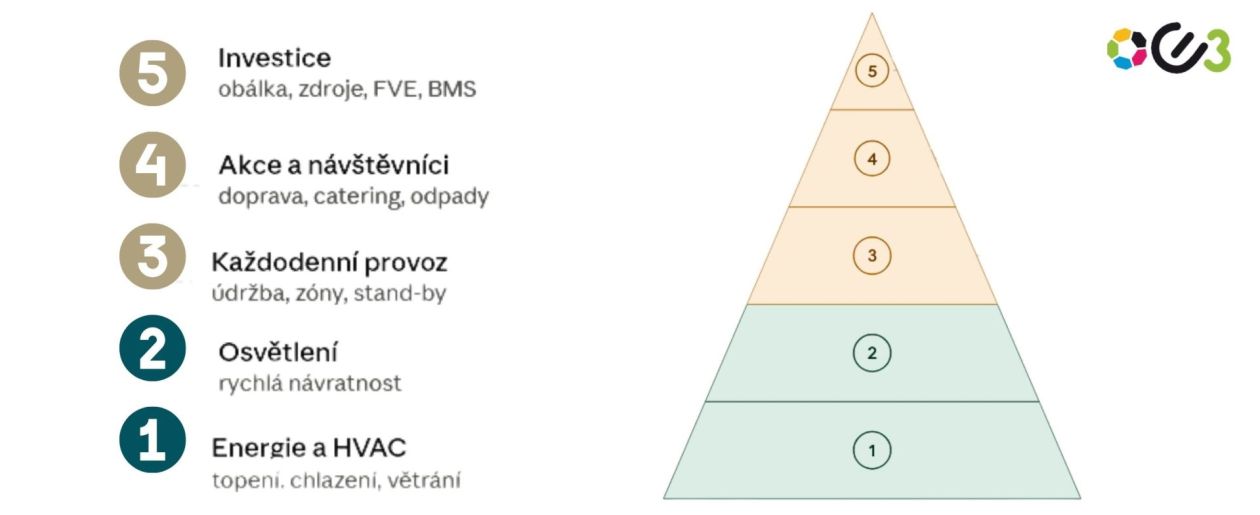
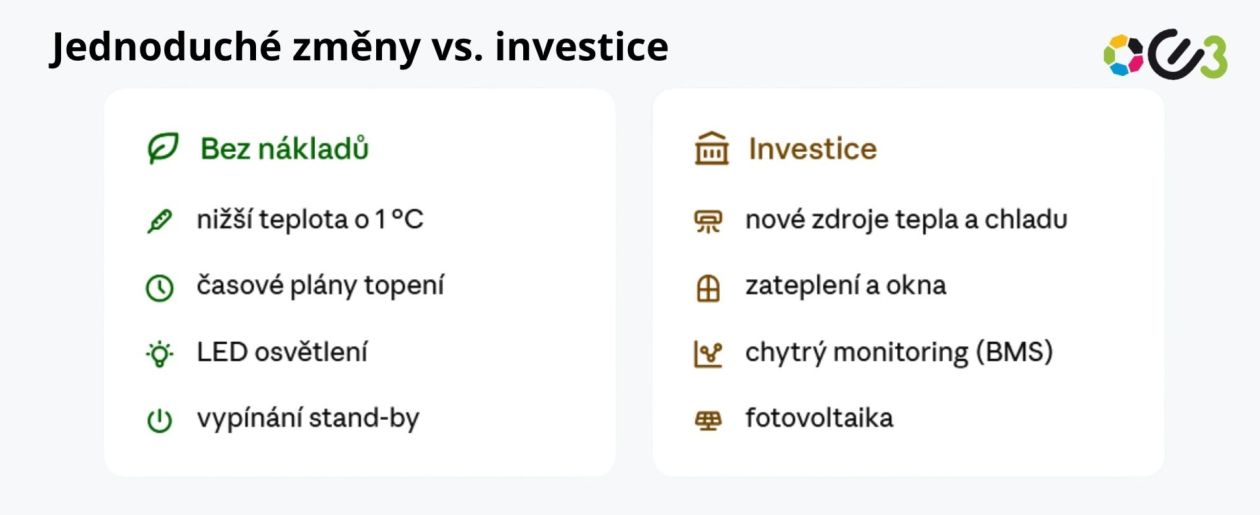
Naturally, the first priority should be low-cost or no-cost measures. Something as simple as lowering indoor temperatures by one degree Celsius can typically reduce heating demand by around 5–10%. Strategically scheduling HVAC operation, introducing zoning, separating "event" and "non-event" operating modes for auditoriums and foyers, and eliminating unnecessary standby power consumption are often among the quickest and most cost-effective improvements. Once these measures have been implemented, organisations can consider larger capital investments, including building insulation, modern heating and cooling systems, building management and automation systems (BMS/BAS), and photovoltaic installations.
Only after these fundamentals are in place does it make sense to introduce the more visible sustainability measures associated with events, such as reusable tableware, simplified catering standards instead of single-use materials, encouraging visitors to travel by public transport, or applying green procurement principles when contracting cleaning services, lighting, or construction work.
It is equally useful to establish a small set of key performance indicators (KPIs), such as energy consumption per square metre, energy use per event, waste generated per event, or the proportion of reusable solutions. These indicators make it possible to monitor progress over time based on measurable data rather than subjective impressions.
Today, many cultural institutions devote considerable attention to waste management while paying relatively little attention to heating and energy consumption. From both an environmental and an economic perspective, this priority is often reversed. Highly visible sustainability initiatives—awareness campaigns, reusable cups, or recycling bins—certainly have their place, but they are rarely the measures that deliver the greatest reductions in carbon emissions. The most meaningful improvements usually happen where visitors never look: in temperature settings, lighting schedules, and the way a building is operated on days when no events take place.
The good news is that cultural institutions do not need a fifty-page sustainability strategy, nor do they need to wait for ideal political or financial conditions before taking action. A practical approach is to start with data, identify the two or three largest sources of emissions or energy use, and focus the first year on implementing realistic, measurable improvements. This is precisely the philosophy behind projects such as GreenCult, and it is also the approach we are happy to support together with cultural institutions and their governing bodies beyond the project itself.